As we all know, food is an incredibly precious and vital resource, yet globally, 33% of all food produced ends up wasted, and the processing of that waste accounts for 8% of all greenhouse gas emissions. The stats are even worse for fruit and vegetable crops, where a shocking 45% of produce gets wasted. Thankfully the world is becoming increasingly conscious of the need to make our practices more sustainable, these numbers are a reminder that we still have a way to go.
Stop Food Waste Day began in 2017 and is now a worldwide initiative, focused on raising awareness, educating people, and inspiring change at every level, from the individual household to large corporations: we can all do our bit, and that includes talking about the issues we face, and how we can tackle them.
That’s why here at J L Priestley & Co Ltd, we are proud to champion this worthy initiative, and share some of the ways that we work to create as little food waste as possible, and dispose of the waste we do create in a responsible and sustainable manner.
Mindful Manufacturing
Businesses operating in the food industry such as ourselves have a huge responsibility to ensure that we are doing everything we can, and always pushing to do more, to create the most efficient and sustainable produce with as little waste as possible. We take this responsibility seriously, and have a number of initiatives underway.
When we process ingredients, cleaning, cutting or milling it on our production lines, we retain 99.9% the original ingredient, with that extra 0.1% accounting for the dust lost to the air. You may think that small quantity is just lost to the wind, but in fact, we collect all the sweepings and dust that settles in our factory. It is collected from us by an approved collector, and taken to an AD plant (as many of these are in Lincolnshire, it often doesn’t even have that far to travel!). To those not in the know, an AD Plant is an Anaerobic Digestor, which uses microorganisms to break down the food waste. This creates biogas, which is harvested to create electricity, to be used by the National Grid as renewable energy.
And it doesn’t stop there – there is a slurry left over, called ‘digestate’ – which is rich in organic matter and is perfect for fertilising farm land, which is exactly where it goes. We are proud to say that NONE of our produce goes into landfill.
And that includes our packaging! We recycle our cardboard boxes and our plastic bags, separating them out on site to ensure these is no cross-contamination.
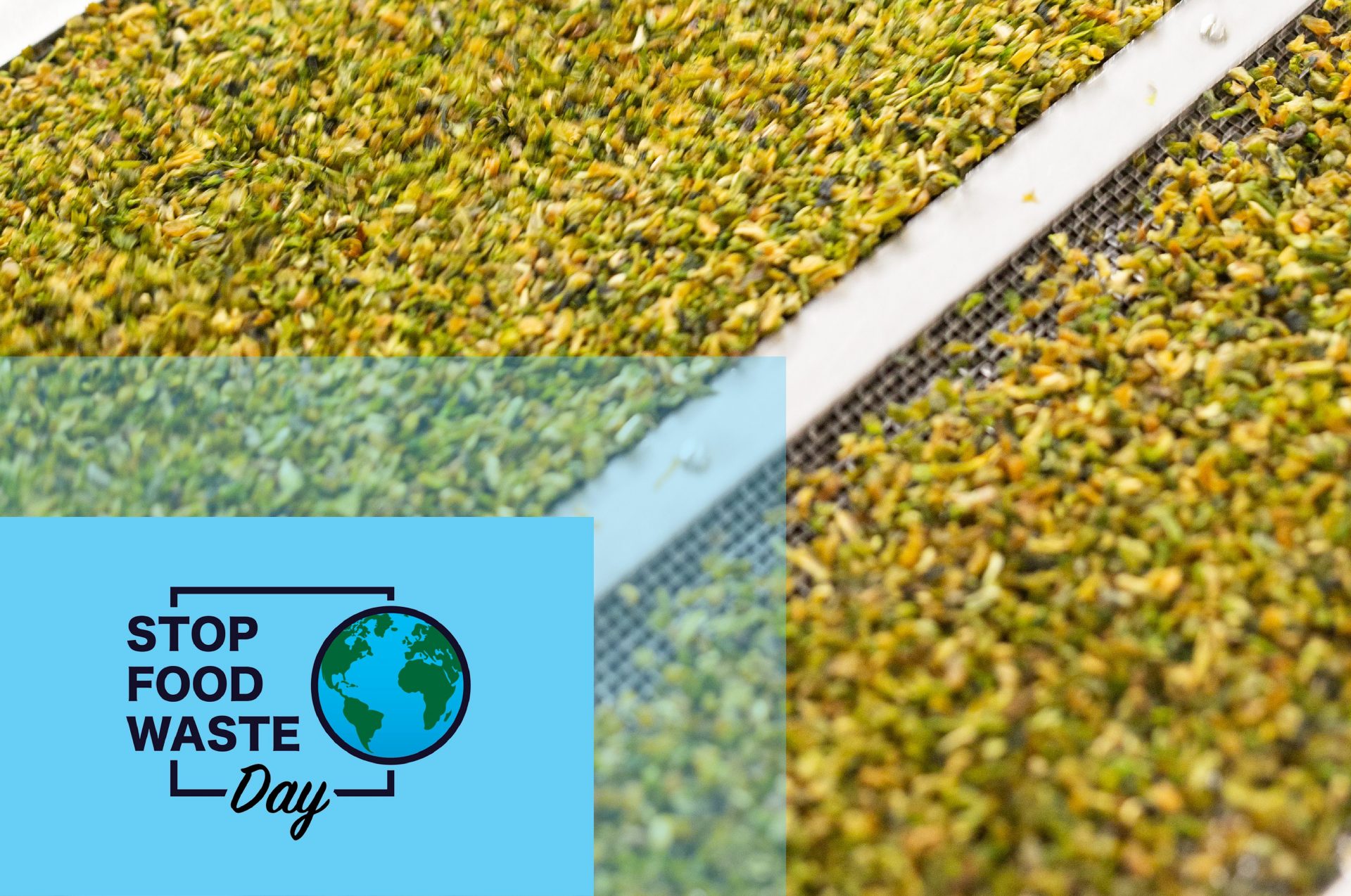
When we use our Urschel to cut ingredients into different sizes, such as 2-6mm or 1-3mm size pieces, we use graded sieves to extract the larger chunks, which go back in the machine to be reprocessed, and we collect the byproduct which is too fine for the grade in question. This fine material accounts for about 30-40%, a considerable quantity. We find a new life for it by milling it into a powder, or processing it another way to fulfil a different order, to ensure nothing goes to waste.
The steps we have taken to Stop Food Waste in our own business is a small contribution when considering the scale of the challenges we face globally, but we are pleased to be doing our part. As we look into the future, we will always be considering how our operations can be made more efficient and less wasteful, and better for all the planet, we call this mindful manufacturing.